Thursday, 20 September 2012

Following in the Footsteps of Dr Robert Laws

Wednesday and Thursday were spent at two of the hospitals set up due to the vision of Dr Robert Laws. Dr Laws came to Malawi as a missionary in 1875 after reading the travel journals of Dr Livingstone. His great aim was to proclaim the whole gospel of Christ to the whole person, and part of his legacy is found in the three mission hospitals as Livingstonia - his base in Malawi from 1894 to 1927; Ekwendeni and Embangweni.

Wednesday began with a walk with Bob down to the reed bed to look for birds, where we saw a black kite. I then joined Katherine in going to Ekwendeni to met with Stallin and Velepe as they went into one of the local villages to do the youth and community aspect of the VTC. With the help of the VTC programme the village seeks to support all who live their, focusing those who are least able to support themselves - especially the youth and the victims of AIDS. We arrived at children's time to join the after school activities. Katherine had brought some simple play equipment, which soon had the young people enjoying themselves immensely. Katherine then took a picture of the younger ones, and found herself swamped by a group of excited children as she showed them the picture.


We were taken to see some of the work the village were doing to help their younger members; including planting gardens to grow maize to sell as a means of income, and providing a nursery for saplings - as the village sought to plant 10 tress for each one they cut down. We also joined the village Home Care Team as they visited one of the AIDS patients - providing basic home help support to a woman who was struggling to survive.

Although the work of the VTC is not directly hospital based, it provides support to the local communities as they bring the whole gospel to the whole person.


Thursday was a much longer journey - up to Robert Laws' main base at Livingstonia. This is a journey of about 145km, taking about three hours - with the last 15 km taking at least one hour of that time as you travel up the Garodie Road - a dirt track running up the side of the hill from the Lake. Originally the mission station was based at the lakeside, but moved to the plateau to avoid the heat and the mosquitoes. Overall, the road has 21 hairpin bends, which make Fiddler's Elbow look like gentle turns in the road, and around which even a 4X4 struggles.

Livingstonia is centred around two main buildings, the hospital and the church. The present hospital was built in 1904, and provides care for around 8000 people - from the Lake, where some of the clinics are run from boats; to the high plateau, most of which is only accessible by 4X4. Some of the best views of the plateau are provided from the church tower. At the back of the church there is a stained glass window which depicts the meeting of Dr Livingstone with Stanley the explorer. These two buildings set the atmosphere for the whole of the mission compound, and it certainly is a special place, and it was a privilege to be able to visit it.

The visit was enhanced by two encounters with nature. While I was talking to the retired minister who now runs the museum based in the original house built by Robert Laws, I was surprised to see a bird pf prey swoop down and take a young chicken from about 10m in front of us. It all happened so fast that it left me momentarily speechless as I struggled to take a shot of the bird flying away. And as I walked back to the hospital to meet my traveling companions, two girls pointed to a bush - and there was a chameleon, its beady eyes on the butterflies inspecting the flowers. Two sites I never expected to see at the end of a wonderful day.


Tuesday, 18 September 2012

Yellow Bird


Back when I was young Sunday was often punctuated by Harry Belafonte singing about a yellow bird on Two Way Family Favorites. Well, it was another Sunday, and this time there were two yellow birds - one in the morning (a weaver bird) and one in the evening (a canary). Between them I had my first experience of preaching in translation. We went to the edge of the city to a small community called Kaningina, perched on the top of a hill at the end of a long and dusty road. Here there was a prayer house - the home of a relatively new congregation, planted in the last few years. Here they had a wooden room, which doubled as a classroom for the small local primary school. Although the congregation was quite small, they still managed to run three small choirs. Like Wales, this is very much a land of hill and song.

Preaching in translation is certainly a strange experience. You are just warming to your point, and you have to stop to let the translator catch up. This is both frustrating and helpful - it is frustrating because you keep on loosing the flow, but it is helpful because it gives you a pause to frame what you are going to say next. Either way, it seemed to work, as once or twice the congregation responded with a resounding Hallelujah. Of course, it may have been that the translator was preaching a much better sermon than I was.

After the service we had lunch at the church, and a look around the site. The school was run by the church and had only 240 children, taught in four classes. They hoped to expand, as the oldest class is currently taught in the next community because of lack of space. And perched right on top of the hill is the new church building. So far they have built the walls, and now they are raising funds for the roof. It was good to be here and to share fellowship with this community.


Yesterday morning (Monday) was spent organising trips fort he rest of the week. Tomorrow I will be going to visit some of the Youth Clubs run by the VTC, while next Monday I will be walking through the bush to see some of the water wells maintained by the Synod with the help of the Raven Trust. The afternoon was spent sorting glasses for the team of eye specialists - they are hoping to set up a dispensing outlet for people in the community. This was their last day with us before they go north to Livingstonia, and so we had a cake to bid them farewell. Apart from the cake, this was a typical evening so far, as we sat around the main room in the Mission House and shared the experiences of the day. No day goes the way it has been planned, but every day has its good tales to tell. And as the eye team leave us, a team of dentists will come to take their place on Wednesday - and another cake will be baked and iced.

The current Mission House, on the CCAP (Church of Central Africa - Presbyterian) site in Mzuzu, is soon to be reclaimed by the Synod to be used as the residence for the vice-chancellor of the University of Livingstonia, so one of John's current projects is to build a new Mission House just outside the centre of town. I was there for most of today, painting the walls. The house is almost finished, and it is hoped that we will move there by the end of the month - as long as we can get the electricity put on. At the moment we are waiting for the delivery of a telegraph pole from the national supplier, ESCOM. Tonight it was not only the new Mission House that was without power. It meant we had a candle-light supper, and were able to see the Milky Way crossing the tail of Scorpio.

Which brings us to the end of another good day. And remember - road signs save lives - at least, according to the road sign you see as you leave the centre of Mzuzu on the way to the new Mission House. Travel well in your journey with God.


Sunday, 16 September 2012

Sports Day

Waking up to another Sunday morning and getting ready for morning worship - today I am off to one of the small Prayer Houses with the Rev. Levi Nyondo. The congregation will be much smaller than last week - possibly around one hundred. But it is a most un-African morning, with overcast skies and a chill breeze.

Yesterday was so different, as dawn broke over the hills to the east, heralding a day of bright sunshine - which was something of a problem, as we were holding a sports day for the youth club up at Ekwendeni. A few days ago another group joined us in Muzuzu. Most of them are eye specialists, seeking to carry out clinics at Ekwendeni and further north around Livingstonia. But one of the group is a retired sport's mistress, who will be working with schools and youth groups. And so we set off to see what we would find.

What we found was about 140 young people - from about 8 to 18. They were part of the community attached to the VTC - Voluntary Testing and Counseling Centre, which delivers the AIDS prevention advice to the local area, and also provides a variety of other programmes to help with education and access to work. For the morning we had organised football and netball - which was fine, except that I was to referee the football matches. So there I stood, taking charge of the junior game. I think I did okay, there were no riots, and both sides were happy with the result - but the locals felt that I did not use the whistle enough. So I was replaced for the senior game - probably a sensible step, as there was history between these two youth club teams. Still, the morning went well.
 
For the afternoon we had arranged a rounders knock-out competition. Because of a local senior league match we had to play this in a different area to the football. Although most of the children walked to the second site, a few chose to take a ride on the back of the VTC pick up. The games proved a little chaotic - rounders is not a traditional game in Malawi. But the locals soon picked up the rules, and in the end the winning team proudly lifted the cup high in triumph. After the game we some of the local children wanted to display their prowess with a hula-hoop. However, this demonstration had a twist to it - the hoops were made out of old bicycle wheels with all the spokes removed. With their friends singing in the background, the young girls walked up to the crowd and back - keeping the hoops high all the way.


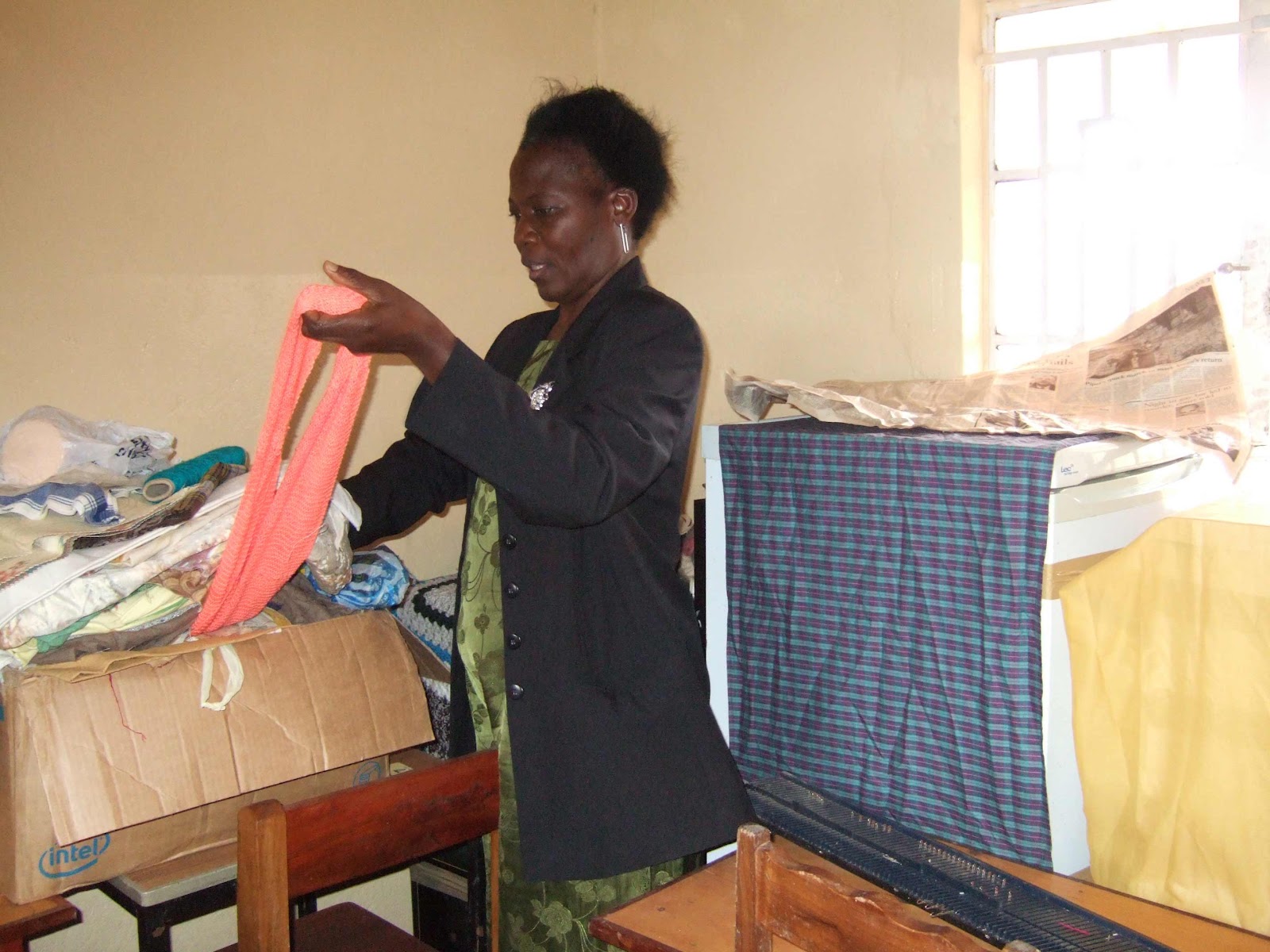
However, it was a bit of a rush to get back for my next appointment - we were going to the Craft Centre to a place called Hill Top - the highest spot in Muzuzu, from where there are good views of the whole city. The Centre is right at the top, and there I found the final destination of some of the sowing machines and much to the fabric we have been sending out via John. The Centre was set up by the local Synod, and is run by Levi's wife, Ruth. She works with many of the local women to produce craft work for sale, and while we were there she was demonstrating how to make a simple school bag, and how to crochet. It was good to see how the old machines we have been collecting over the years are being used. Of course, they have also been used in other projects - one of the main ones has been to provide pastors wives with machines before they go into their villages - and some of those wives will be coming back next week for a week of ideas and training to use back home.


Friday, 14 September 2012

Mainly for Andy

Yesterday and today have mainly been meetings indoors, so most of this Post will be pictures of some of the birds that fly past the bedroom window each day. I wanted it to be of wild life in general - but the slender mongoose that comes by each morning at 6.00 am has so far been effective in its desire to be camera shy.


Although that introduction sounds very dry indeed, it has been a good two days, as the people I have been meeting have been quite inspiring - Major Hyancin Gondwee is the outgoing secretary for lay training and mission; while Francisco leads an ecumenical evangelistic group consisting of two choirs, actors and a couple of preachers - they get about three thousand turning up to their outdoor rallies, one of which I should be joining next Saturday.

But the highlight of this time was last night - joining Witnesses for Christ for one of their regular evening get-togethers. This is a choir of people working on the mission station at Ekwendeni, whose work includes prison visiting as well as raising money for charities by giving concerts. They sang the standard call and response type of African song, led by Major Gondwee's daughter Glory. We had hoped to teach them an English song - He came from heaven to earth - only to find them singing it just before handing over to us. However, we did find that they did not know You shall go out with joy - so we finished the evening with that. I had hoped to put up a video of The Witnesses singing one of their songs, but the lighting gave everyone a blue tint that turned us all into Smurfs. It was a great evening, and hopefully I will have a chance to visit them again when some of the other visitors to the Mission House finally arrive.

Tomorrow I will refereeing a football match! One of the group that joined us on Tuesday is a retired sports mistress, and she has organised a sports day for the youth club on the Mission Station at Ekwendeni - with football, netball, and a series of other games. We expect about a hundred kids overall. It should prove fun - if a little hot.

But for now, a few pictures of the local bird life - ask Andy if you need someone to identify them.


Wednesday, 12 September 2012

Theology Today

Back once more to Ekwendeni. This is an arid countryside, but with the hills in the distance, there is a grandeur about the place that is hard to find elsewhere. After yesterday's excursion into the countryside, today was spent in the groves of academe - at the Theological College. I left early with Rev Levi Nyondo to get to the college for morning prayers, and there was asked to give the short address they have each day. It was a reflection on II Timothy 3:10 - Paul's encouragement to Timothy to copy what he had seen in his life. It was an expression of something that has been forcing its way into my thoughts - gratefulness for the work of the early missionaries, and the way that the Christian witness has grown as the church in Malawi copied them. And a plea that the church here does not follow the path that Europe has taken in recent years - with a complacency that we had it all, and forgetting that we needed to continue to proclaim the message and not assume that those around us and those who were our children would receive the gospel by osmosis. Through it all, the words of Crosby, Stills, Nash and Young echoed in my mind - teach your children well.

After morning prayers, there was the tour of the college - and a reminder of Pitlochry, for the church there had provided the funds for some of the development here. It should not surprise anyone that the building I found most interesting was the kitchen. Here the two cooks prepared meals for the 30 or so students studying for the ministry - either doing a three year diploma or a four year degree. Accommodation - and cooking - is fairly basic, with married students having to live apart from their families in term time.

After the tour I had a chance to sit in on some of the lectures, and in two of the sessions there was time for questions and answers. One was after the Principles lecture on preaching, the other replaced the lecture in Old Testament Theology that should have been given by one of the staff members who was on sick leave. We had a good time, and I was very pleased to have spent this day with the students and staff at the college. I hope that I will be able to return some time later in the stay here - with a little more of a structured programme to the day. We will wait and see.

The team here has been increased somewhat as a fully integrated group of eye specialists have joined us, hoping to do some clinics at Ekwendeni and Livingstonia, and to set up the infrastructure to hire some ophthalmic technicians to continue the work. In the afternoon I joined them in the Tanzanian Market - a bazaar of a place that specialises in clothing of all sorts, all tucked away in narrow dark alleys running on a grid, full of colour and bustle. And then in the evening the team joined us for chili con carne -a good end to a good day.


Tuesday, 11 September 2012

Care in the Community

I am spending a few days in Ekwendeni - the main mission station of the Presbyterian Church in Malawi. The station contains all aspects of mission - within the compound can be found a theological college, a nursing school, schools for the blind and for girls needing secondary schooling, a whole variety of youth work and community based work, and a general hospital.

Yesterday I had the introductory tour of the complex, meeting people involved in many areas of the work. They do very well as they try to serve their community, but the contrast between what we have and what they can provide is stark. However, some of the statistics are encouraging - especially in the area of AIDS. The proportion of those testing positive for HIV has dropped dramatically in the younger generations, and survival rates have risen for those who have been infected. Two statistics point out the progress that has been made. Maternal transmission to new born babies has dropped from 95% to 5%, thanks largely to compulsory testing of pregnant mothers and the corresponding ability to take preventative measures during birth and breast feeding. And in some areas nutritional programmes linked to the provision of anti-retroviral drugs have reduced the death rates for maternal infected children from about one a day to about one a year in those areas.

If yesterday was about listening to the theory, today was about seeing the practice - I went out with a community health team. These teams work with pregnant women and young families, providing anti-natal care and general health checks for children under five.The team leaves the hospital as soon as they can; which all to often is quite late because there are not enough vehicles in a roadworthy state, and everyone has to wait their turn.

The team drive to the clinic - a bare hut in one of the local communities; where the mothers and mothers to be are waiting in whatever shade they can find. The programme begins with encouragement and information - including a song about family planning, sung with a true African beat and encouraging the women to make sure they space their pregnancies to ensure each child has a chance to grow well in its earliest years. There are then talks on breast feeding and nutrition, general health and HIV, and the need to use mosquito nets for the babies. As it happens, in this clinic, there were also free nets for each child, which were to be distributed at the end of the clinic.

After the songs and the talking came the clinic itself. There were anti-natal check-ups and injections for mums to be; weighing, measuring and injections for babies and young children; and family planning advice and AIDS testing for the new mums (pregnant women would have been tested at the hospital when they first knew they were pregnant). Any problem that are discovered at the clinics, including malnutrition, are referred to the hospital for further treatment - and one of the vehicles took one woman back to the hospital with her child when we left the clinic to go home.

Of course, this time there was the distribution of the children's mosquito nets, but soon we were on our way back to the hospital, where the kitchen had laid on a meal for the staff (and helpers) - chicken, rice, cabbage.

Tomorrow I am back to Ekwendeni to go back to college, starting with morning prayers. More of that later.


Sunday, 9 September 2012

Sunday Services in Muzuzu

They say a new broom sweeps clean - and after yesterday's/Saturday's efforts I can see why. We were down at the new mission visitors' house - the one I should have been staying in, but they are still building. They are now decorating the walls. But before putting the paint on, we needed to sweep out the plaster. As there is no electricity yet, we needed a broom - the old type of broom, made of broom (or the local equivalent). And when you see an old broom, and a new broom, you can see why the new one sweeps so much cleaner. Then it was painting walls in white undercoat. It will certainly fill in any spare time!

Today/Sunday was a day for worship. The 8 o'clock service was advertised as one and a half hours. This was the English service - to be followed at 10 by the service in Tambuka - the local language. When the service began, the church was quite empty - but slowly it filled up, until there was standing room only. Although the sermon was only twenty or so minutes, we had to leave before the end (at about 10 - the Tambuka service was going to be late) to attend another service. The main reason for the length of the service was the choirs - five of them. One was visiting from a daughter congregation, but the others were home grown - with another set ready to take the Tambuka service. They covered the whole range of African music - male, female, mixed, acapala, call and response - it was very good. The other reason for the timing was the intimations - notices that went on for at least fifteen minutes. Mind, I took up a couple of those minutes. They introduced the visitors and asked us to say a few words about why we were here - so I was able to bring greetings from Llanwenarth.

We were whisked away to go to the local Guild district meeting. In our terms, this was the Association gathering of the Ladies' Meetings - only much, much bigger. About a thousand ladies from all over Muzuzu gathered together in their distinctive clothing. We were promised a two hour service. Four and a half hours later we were finally free to have lunch! In truth, I enjoyed the service. It was in Tambuka - so I did not understand a word, but the singing and the atmosphere were great. Again, the visitors were introduced - so I wished them bore da (as it still was - just).

The service was so long because the Guild Co-ordinator was standing down after twenty year' service - and so there were gifts and thanks and songs. But they were nothing like British versions of those events. First, the Guild as a whole brought in a whole three piece suit - parading it down the aisle, held head high. But that was not the end - after that, each individual church Guild brought their own gifts - sacks of maize, frying pans, even a whole chicken. And as they came down the isle, they sang their own Guild's song. The now ex-co-ordinator was overwhelmed. By the end of the service the Guild had provided enough to re-furnish her house, and to feed the family for the next couple of weeks.


And, of course, as with any Ladies' Meeting, there was food to follow - and by 2.30 we were all ready to eat. This was cooking on a grand scale - goat, beef and chicken stews cooked in five gallon pots; stewed cabbage; rice and seema - something rather like polenta. As ministers and guests, we were sat at table. The others were scattered around the church compound, eating in groups and enjoying the company. They had clearly had a good time over the weekend, and now was the time of parting as they prepared to return home.

So it was a good start to the week that lies ahead. Tomorrow we are going further north, to Ekwendeni to see the hospital and the orphanage, while on Wednesday I will be at the theological college. It certainly is a great privilege to be here, even if I am not too sure what lies ahead.